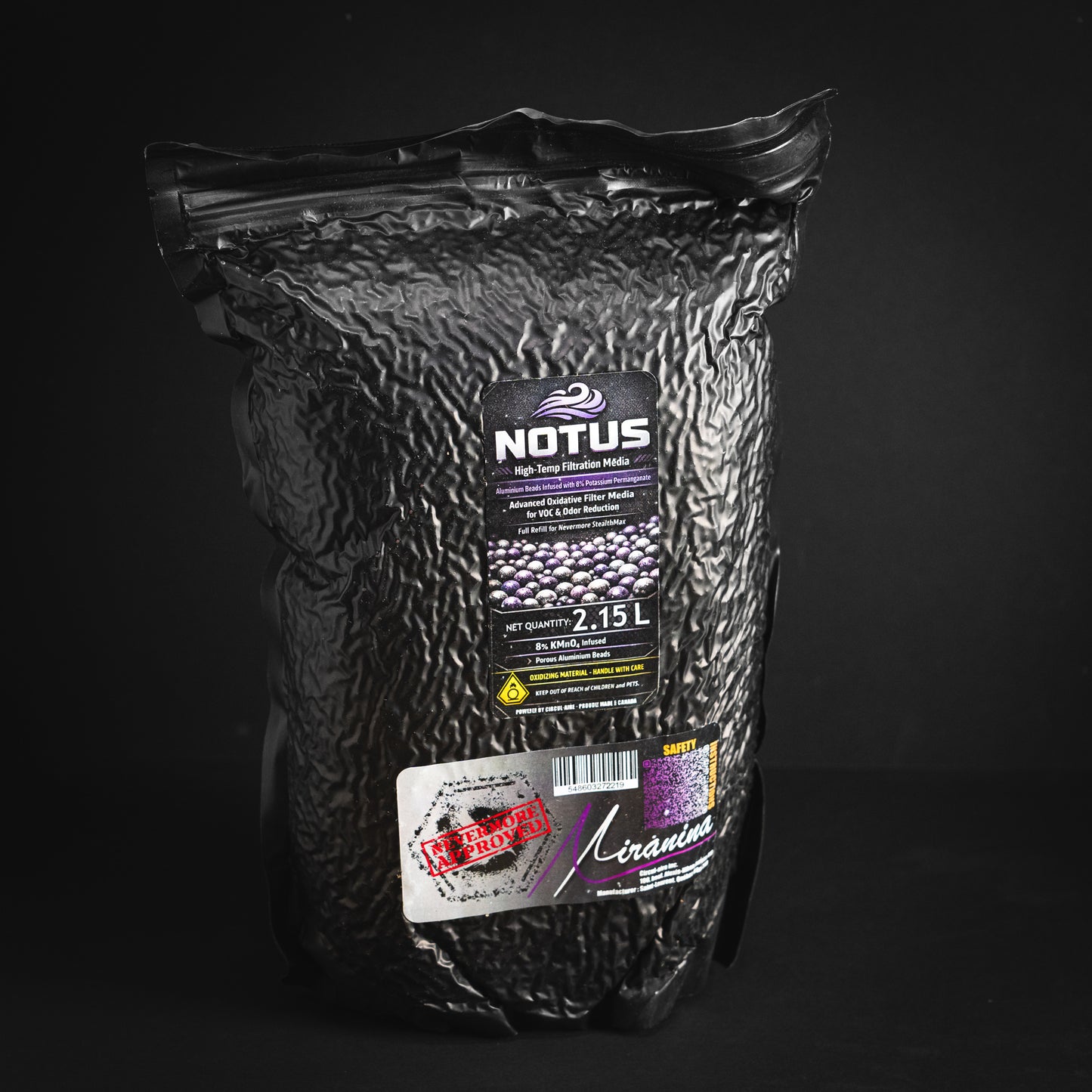
Nevermore-Approved Notus™ Potassium Permanganate Media
Alumina beads infused with 8% potassium permanganate (KMnO₄).
Uses the same active oxidizer found in Nevermore Scorch-style media, but on an activated alumina substrate.
Nevermore-approved by Ondsk4, creator of the Nevermore project.
Made in Canada.
Features
Optimal Quantity
Each vacuum-sealed 2.15 L (~1.6 kg) bag completely fills one Nevermore StealthMax V1.
Customizable Use
Can be mixed with activated carbon to extend service life while maintaining moderate chemical filtration.
Long Shelf Life
Shipped in a resealable vacuum-sealed bag, allowing partial use while helping preserve freshness.
Typical Properties
H₂S Capacity (minimum)
0.10 g H₂S/cc
Moisture
22 wt%
Compaction (minimum)
2.7 kg (6 lb.)
Particle Diameter
3.2 mm (1/8 in.)
Apparent Density
0.88 g/cc (55 lb./ft³)
Pressure Drop @ 50 fpm (0.25 m/s)
1.0 in. of water/ft. of bed
Performance in Heated Printer Chambers
Notus is better suited than carbon-only media for hotter printer chambers because its
KMnO₄ chemistry does not rely solely on physical adsorption.
Activated carbon loses much of its adsorption capacity as temperature increases, while
potassium permanganate continues to chemically oxidize many contaminants.
Actual performance still depends on airflow, media quantity, humidity, chamber conditions,
contaminant concentration, and print duration.
Why Activated Alumina Is a Great Match for 3D Printing
Moisture Management:
Activated alumina is hygroscopic. In a recirculating printer chamber, the enclosed air repeatedly
passes through the media, giving the alumina additional opportunities to adsorb moisture around the
filter bed. This may help support the KMnO₄ chemistry, but it is not a replacement
for properly drying filament before printing.
Improved Chemical Contact:
The porous alumina substrate helps bring gas molecules into close contact with the KMnO₄
(the purple stuff), allowing adsorption and chemical oxidation to work together for more effective
contaminant removal.